



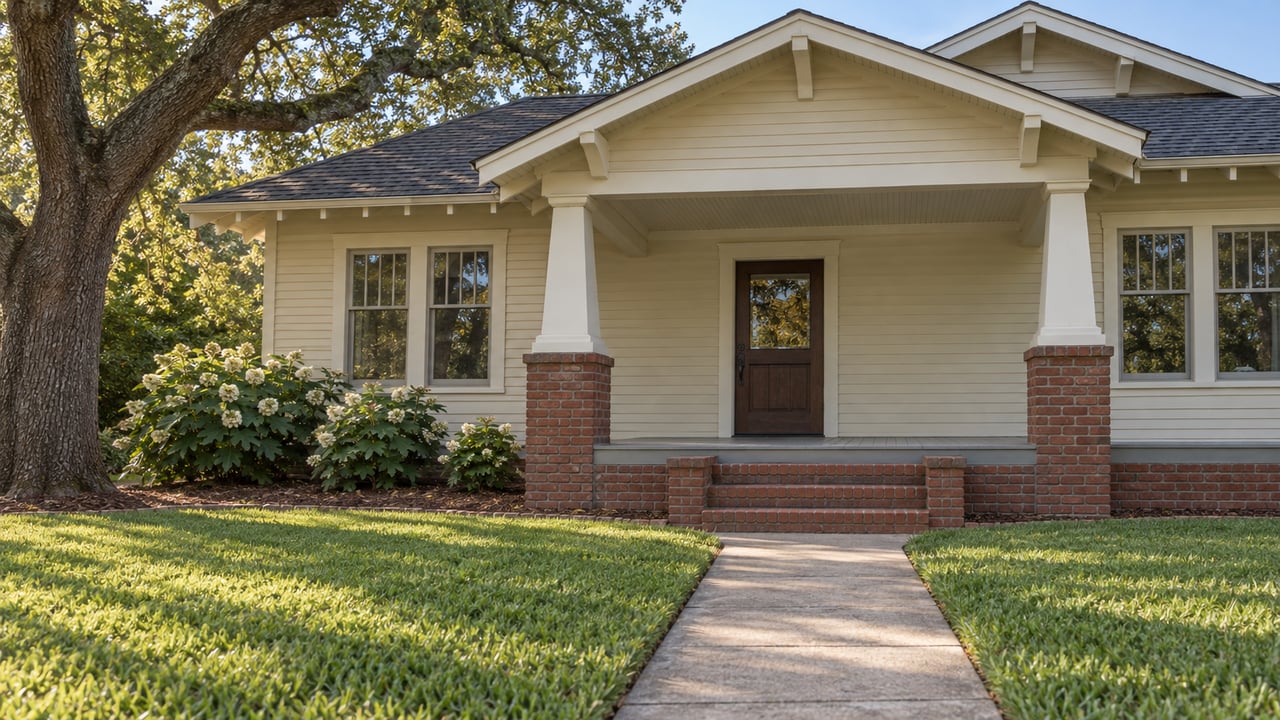
Say your insurer wants proof that the roof on your 1920s house has some life left, or you want rated shutters to qualify for a wind-mitigation discount. Who has to sign off before the work starts? In much of Ortega, the answer is you, a licensed contractor and the building department. A few blocks north in Avondale, a fourth party joins them: the City of Jacksonville's Historic Preservation Section, and sometimes the full Jacksonville Historic Preservation Commission.
That extra review affects how long roof and window projects take and what they cost. Those happen to be the same projects that Florida's insurance rules tend to push older homes toward.
Two kinds of "historic," and only one of them regulates
The City of Jacksonville recognizes two kinds of historic designation, and its own explanation is unusually direct. In a locally designated district, every exterior change needs an approved Certificate of Appropriateness, or COA, before work begins. National Register listing, by contrast, "is an honorary distinction, and it does not regulate changes made to landmarks or properties in historic districts."
The same page then names the neighborhoods. Most of Ortega is a National Register district but is not locally designated. The larger Riverside-Avondale Historic District is a local district, and it contains two smaller National Register districts, one for Riverside and one for Avondale. The National Park Service registration form for the Old Ortega Historic District describes its footprint as bounded by Roosevelt Boulevard, Verona Avenue, the St. Johns River and the Ortega River.
Ortega's listing still carries one obligation. The city notes that demolishing a National Register listed or eligible property in Jacksonville requires review by the Historic Preservation Commission. For roofs, windows, shutters and additions, the honorary listing adds no city design review.
In Riverside-Avondale, the COA requirement covers exterior repairs as well as replacements. The city's COA process page lists window and siding repairs, fences, driveways and sheds. According to the city's Historic Preservation FAQ, interior work that doesn't affect the exterior needs no COA. Boundaries don't always line up with neighborhood names, so check the specific parcel on the city's Search by Address map. The city says properties inside a local district boundary need a COA for exterior changes, noncontributing properties included.
The roof: where the insurer's clock starts
Florida's statute on roof age bars an insurer from refusing or nonrenewing a policy solely because a roof is less than 15 years old. For a roof 15 years or older, the insurer must allow an authorized inspection, and it can't deny coverage based on age alone if that inspection shows at least five years of useful life left. The state's four-point inspection guide explains that insurers commonly require these inspections to check roof, electrical, plumbing and HVAC condition. It also notes that insurers may ask for proof of five years' remaining life on shingle roofs older than 15 years or tile and metal roofs older than 20.
When that inspection leads to a reroof in Avondale, the city's 2026 COA Matrix decides the path. A roof that matches the existing or documented historic roof in design, and in color where color is character-defining, qualifies for staff review. So do roof material changes the Florida Building Code requires. A design that doesn't match, or roofing that is questionable for the house's architectural style and isn't required by code, goes to the Commission. The district's 1992 design guidelines call for keeping the original roof form and matching deteriorated surfacing, with more flexibility where the existing material isn't original.
For a buyer, the practical question during the inspection period is whether the roof that would satisfy the insurer is also the roof the district would approve at staff level. When the answer is a like-for-like replacement, the extra step is small.
Windows and shutters: where the two paths split
Openings are where insurance incentives and preservation standards pull hardest against each other. The state's July 2026 consumer guide to hurricane mitigation discounts says insurers must offer discounts for qualifying features, including opening protection, documented by a qualified inspector on the uniform mitigation form. A new version of that form applies to inspections from April 1, 2026, and stays valid for five years unless there are material changes or inaccuracies.
The city's May 2024 window supplement starts from repair. It asks that existing trim be kept, that installation stay traditionally recessed, and that replacements match historic window patterns. Staff can't approve permanent nailing fins or muntins that sit only inside or between the glass. The supplement also presents exterior storm windows as a way to protect historic windows and improve energy performance. The older district guidelines say shutters generally need physical or documentary evidence that the house once had them. Wood louvers are preferred, and metal or vinyl are discouraged.
Here is how the 2026 matrix sorts the common jobs:
| Work in Riverside-Avondale | Staff review | Commission review |
|---|---|---|
| Historic window, contributing house | Irreparable window replaced to match design and arrangement in wood, wood blend, aluminum-clad or like-for-like material | Repairable historic windows, incompatible designs, vinyl replacements |
| Window, noncontributing house | Compatible replacement | Incompatible replacement |
| Shutters and storm windows | Historically compatible shutters, exterior storm windows | Alternative or incompatible shutter designs |
| Addition | One story, under 25% of footprint, not readily visible from the street | Over 25% of footprint, two stories, or readily visible from the street |
The city's published materials set no specific COA standard for impact-rated glazing. Before relying on a particular window assembly for a mitigation credit, confirm it with Historic Preservation staff. Florida's 2026 law, Chapter 2026-63, has a glazing provision aimed at new commercial and mixed-use construction. Its building-permit exemption for certain temporary residential hurricane barriers applies only when statutory criteria are met, including compliance with local zoning.
The calendar a COA adds
Most COAs stay at staff level. The city's Historic Preservation FAQ puts administrative review at about one to two weeks. Commission review takes at least a month, and the city suggests applying about six weeks before the meeting. The Commission usually meets monthly, most often on the fourth Wednesday.
Commission review carries a fee schedule:
- $315 for alterations
- $495 for additions, new construction or relocation
- $610 for demolition
- Double the applicable fee once a notice of violation has been issued
That last line is a good reason to ask about exterior work a seller has done before you close. Applications go through the city's LUZAP portal, and an approved COA stays valid for one year before work starts and five years once work has begun.
Review timing also depends on a house's classification. The city's 1985 survey labeled structures contributing or noncontributing, and structures not on that list are evaluated individually. Under the matrix, fully demolishing a noncontributing primary or accessory structure doesn't require a COA.
The tax exemption that comes with the rules
The local designation that adds review also opens an incentive that Ortega's honorary listing doesn't offer homeowners. The city says owners who properly rehabilitate properties in local historic districts may qualify for a Historic Preservation Property Tax Exemption. It covers 100% of the rehabilitation's value for ten years on the City of Jacksonville's portion of the tax bill. Other taxing authorities still tax that value. The rehabilitation can include interior and exterior work, and all proposed work must be approved before it begins. For National Register properties, the city says federal historic tax credits may be available for proper rehabilitation of income-producing properties.
So a buyer planning a substantial restoration in Avondale should treat the COA as two things at once. It is a review step, and it is also the paperwork that can reduce the city portion of the property tax bill on that work.
2230 St. Johns Avenue: a recent Council decision
The process also has an appeal stage, and Jacksonville used it in 2026. The Historic Preservation Commission denied a COA for a new primary structure at 2230 St. Johns Avenue, requested by St. Johns Quarter LLC. The City Council's Legistar record traces what followed:
- February 20, 2026: the Commission issued its final order denying the COA.
- March 12, 2026: the notice of appeal was filed.
- April 21, 2026: the Land Use and Zoning Committee voted 5–2 to grant the appeal.
- April 28, 2026: the full Council granted it 9–8, overturning the denial and approving the COA.
The adopted resolution describes the proposed residence as having street-facing carriage-style garage doors. For a buyer weighing a teardown lot or major new construction inside the district, the timeline is the useful part. It ran more than two months after the Commission's order, and the final vote was 9–8.
Questions buyers ask
Does Ortega's National Register listing limit what I can change? The city describes National Register status as honorary and not regulating changes, except that demolishing a listed or eligible property requires Commission review. Most of Ortega isn't locally designated, but check any specific parcel on the city's map.
Is a noncontributing house in Avondale exempt from review? No. Noncontributing properties inside the local district still go through the COA process, although several jobs, compatible window replacement among them, are handled at staff level.
Where does Riverside Avondale Preservation fit in? Riverside Avondale Preservation hosts the city's design guidelines and points owners to City Historic Preservation staff for the COA process. RAP describes itself as an advocate and liaison, and the city makes the decisions. Its homeowner workshop series includes a session on caring for historic windows.
This post is general information, not legal, tax or insurance advice. Confirm what your property needs with City Historic Preservation staff, your insurance agent and the right licensed professionals.
Sexton and Mock can go over a property's historic status, construction details and likely review path with you, so the inspection period goes into making decisions rather than discovering surprises.